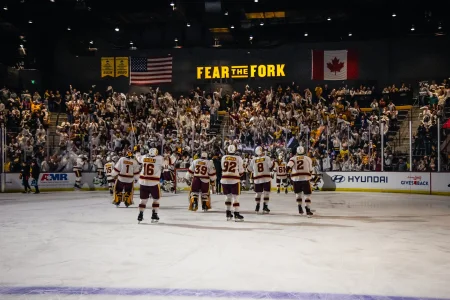

An Arizona State University hockey player remained hospitalized Sunday after collapsing during an outdoor workout Thursday morning, bringing renewed attention to the safeguards used when athletes train in extreme heat.
The player collapsed during an outdoor workout on August 20 and was transported to a nearby hospital. ASU vice president of media relations Chris Fiscus confirmed Sunday that the student-athlete remained hospitalized and said the university was supporting the player, their family and the rest of its student-athletes:
The university offers its support for the student-athlete, their family and all our student-athletes during this difficult time.
Fiscus also declined to identify the player, citing privacy laws.
Tempe was under an extreme heat warning when the player collapsed
August 20 was also ASU's first day of fall classes, meaning formal team activities were permitted to begin under NCAA rules. However, Tempe was a scorching 106 degrees around early afternoon on that date, with temperatures reaching the mid-90s around 10:30am.
When first responders took the call at 8:31am, the city was already reaching nearly 90 degrees, and while the exact time of the collapse isn't known - the incident occurred well before the day's peak heat.
The city had been experiencing a severe heat wave over the past several days temperatures expecting to continue into the 100-degree range. As of this coming week, the city is expected to see averages of 42 degrees Celsius (107.6 degrees Fahrenheit) so the decision to hold any training outdoors seems a bit curious.
The extreme heat warning makes the circumstances surrounding the workout relevant, but there is still a major unanswered question: ASU has not said whether the session was team-sanctioned or an individual workout.
Heat-safety guidelines show why the conditions alone don't tell the full story
The Korey Stringer Institute at the University of Connecticut explains a bit further into the NCAA's guidelines when it comes to heat acclimation:
Heat acclimation is a broad term that can be loosely defined as a complex series of changes or adaptations that occur in response to heat stress in a controlled environment over the course of 7 to 14 days.
Heat acclimatization generally develops over seven to 14 days, according to KSI and among the adaptations are lower heart-rate and body-temperature responses during exercise, earlier sweating and improved performance in hot conditions.
Its heat-safety guidance calls for appropriate work-to-rest ratios, hydration access, medical coverage and cooling equipment to be available when athletes exercise in hot conditions. With classes just starting, there could be other factors that prevented the player from taking the necessary precautions though that is purely speculative.
Arizona State Athletics does have extensive information available to students and the general public regarding the dangers of heat exhaustion, and are utilizing wet-bulb globe technology which takes into account not only temperature but solar radiation, humidity, and wind. The additional question is not how hot Tempe was, but what conditions were measured, if any, at the workout and what safeguards, if any, were in place.
There is not enough public information to determine whether any heat-safety policy was violated. ASU has not said whether the workout was team-sanctioned, what the player's medical diagnosis is, what the WBGT reading was at the time or what precautions were in place.
Those unanswered questions matter. The player's collapse occurred during an outdoor workout on a morning when an extreme heat warning was already in effect, with guidance and acclimation guidelines readily available.
Until ASU provides more information, the focus should remain on the player's recovery while avoiding conclusions about what caused the medical emergency and we here at HockeyPatrol wish the player a safe and speedy recovery.
Do you think the NCAA should restrict outdoor training until the summer is over?
Also read on Hockey Patrol :
Maple Leafs could complete a family reunion by adding Darren Raddysh's brother